
Water heaters
Tank Water Heaters
in Little Rock
No hot water? We repair and replace gas and electric tank water heaters. We find the cause before recommending the fix.
- Master Plumber MP #6781
- Licensed & insured
- 20+ years in the trade
Signs you need water heater repair or replacement
When a water heater stops making hot water, leaks, or gets noisy, we find out why before anyone talks about a new tank.
- No hot water, or not hot enough.
- Water pooling around the base of the tank.
- Popping, banging, or rumbling from the tank.
How we find the cause
Repair or replace? Here's how we decide.
It comes down to the tank's age and condition, what failed, and whether the parts can still be had. Once we work on it, we tell you which way to go and why.
The finding: a tank under 8 years old, with a failed thermostat or heating element.
Repair it.
An older tank with a major leak or corrosion usually needs replacing.
What we check first
No hot water is a symptom, not a diagnosis. These are the three places we look.
The heat source. Electric tanks heat with an element. Gas tanks heat with a burner. Either one can fail and leave you with cold water while the tank itself is still sound.
The thermostat. A failing thermostat gives you water that swings between hot and lukewarm.
The tank. This is where repair or replace gets decided. Sediment settles in the bottom over time and wears on the parts. Rust in the lining leads to leaks. A tank with major corrosion or a leak usually needs replacing. Age counts too: most tanks last 8 to 12 years, and units past 10 have more problems.
We tell you what we found, and what it will take, before any work starts.
Word gets around
Water heater jobs, in customers' words
4.9★ on Google · 20+ years in the trade behind the work
What a water heater repair or replacement includes
- 01
Call and get on the schedule.
- 02
A licensed tech finds what failed.
- 03
You get the real number before the work starts.
What's included
- Finding what actually failed
- Repair of the failed part when the tank is sound
- A new gas or electric unit, sized for your household
- Proper venting and a code-compliant install on gas units
- The permit
- Removal and haul-away of the old unit; testing of the new one
We make the problem the problem, not the price.
How we price
What does a water heater repair or replacement cost?
It depends on what the look finds. A price over the phone is a ballpark.
The number turns on repair or replacement, tank size, gas or electric, venting, and any permit or inspection.
Simple service is billed by the hour. Big jobs are priced per job, with a free estimate.
What is a traditional water heater?
A traditional water heater, also called a tank water heater, heats water in an insulated tank and keeps it hot until you need it.
Parts, gas vs electric, and why it matters
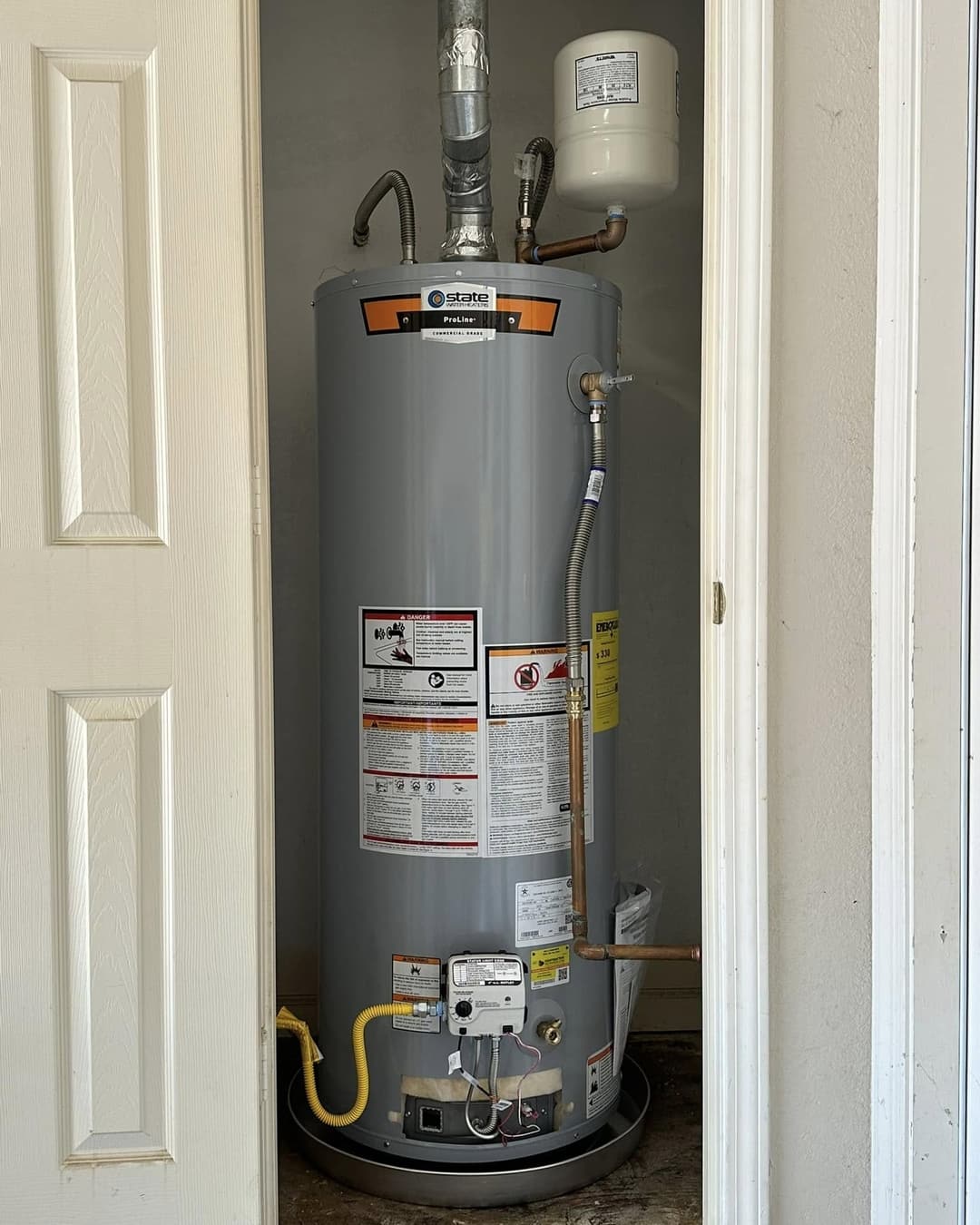
It is the most common kind of water heater in homes. Most have four main parts:
- An insulated steel tank that stores the hot water
- A heating element (electric) or a gas burner (natural gas or propane)
- A thermostat that controls the temperature
- Anode rods that slow corrosion inside the tank
Gas or electric, the tank works the same way. The difference is the heat source. Gas units also need proper venting, which is why a gas install has to meet code.
It matters for three reasons. Comfort: you need hot water to bathe, cook, and clean. Efficiency: a unit that runs right doesn't waste energy or run up the bill. Safety: a failing water heater can leak, burst, or scald.
Weighing a tank against tankless? See tankless water heaters.
What causes water heater problems?
Most come down to sediment, corrosion, a failed part, high water pressure, or age.
The common causes, one by one
Knowing which one you have is the difference between a repair and a new tank.
- Sediment buildup. Minerals and sediment settle at the bottom of the tank, cut efficiency, and damage parts.
- Corrosion. Over time the tank lining can rust, and rust leads to leaks.
- A failed heating element or burner. The water stops heating properly.
- Thermostat problems. The temperature won't hold steady.
- High water pressure. It strains the tank and can make it fail early. If pressure is the problem, see water pressure and pressure regulators.
- Bacteria. Hot water that smells bad often means bacteria in the tank.
- Age. Units over 10 years old have more problems and use more energy.
Other signs worth a call: rust-colored water from the hot taps, temperatures that swing hot and cold, or an energy bill that went up while your use didn't.
How do I make my water heater last longer?
Five habits help a tank water heater last, starting with a yearly flush.
Five maintenance habits
- Flush the tank once a year. It clears out the sediment that settles in the bottom, cuts efficiency, and wears on parts. Maintenance like this can extend a tank's life.
- Check the anode rod every 2 to 3 years, and replace it if it's corroded. The anode rod is what slows corrosion inside the tank.
- Insulate the water heater and the pipes. It improves efficiency.
- Set the thermostat to 120°F. It saves energy and lowers the risk of scalding.
- Hard water? A water softener helps. White spots on faucets and cloudy dishes are the usual signs, and homes on private wells are more likely to have it. A softener slows mineral buildup in the tank.
None of these fix a tank that is already leaking or badly corroded. That is usually a replacement.
Water heater questions
Why is my water heater leaking?
It depends on where the water is coming from. Water pooling at the base of the tank often means the lining has rusted through, which usually means a new tank. High water pressure can also strain a tank until it fails. We find the source first.
How long does a traditional water heater last?
8 to 12 years on average. Flushing the tank once a year can help it last longer.
How long does installation take?
Most replacements take 2 to 4 hours. That includes taking out the old unit and testing the new one.
Can my water heater be repaired, or should I replace it?
It depends on its age and condition, what failed, and whether the parts can still be had. If the unit is under 8 years old and the problem is minor, like a thermostat or a heating element, a repair is usually worth it. Older units with major leaks or corrosion usually need replacing. We tell you which after we look, and why.
What size water heater do I need?
It depends on how many people live in the house and how much hot water you use. 1 to 2 people: 30 to 40 gallons. 3 to 4 people: 40 to 50 gallons. 5 or more people: 50 to 80 gallons.
Are newer water heaters more efficient?
Yes. Newer units have better insulation, recover faster, and have less standby energy loss (the heat a tank gives off while the water sits). That makes them more energy-efficient, which saves energy and money.
Do you install both gas and electric models?
Yes. We service and install both. On gas units, we make sure the venting is right and the install meets code.
Water heater service across Central Arkansas
We work out of North Little Rock and fix water heaters in homes across Little Rock and Central Arkansas. Monday to Friday, 7:30 a.m. to 6 p.m.
Where we work
Related services
Get the right answer
Small things turn into bigger problems.
A drip at the base of the tank is easier to deal with now than after the tank gives out. Call, and we'll find the cause first.